Shopify asks court to dismiss Sezzle lawsuit

Contents5
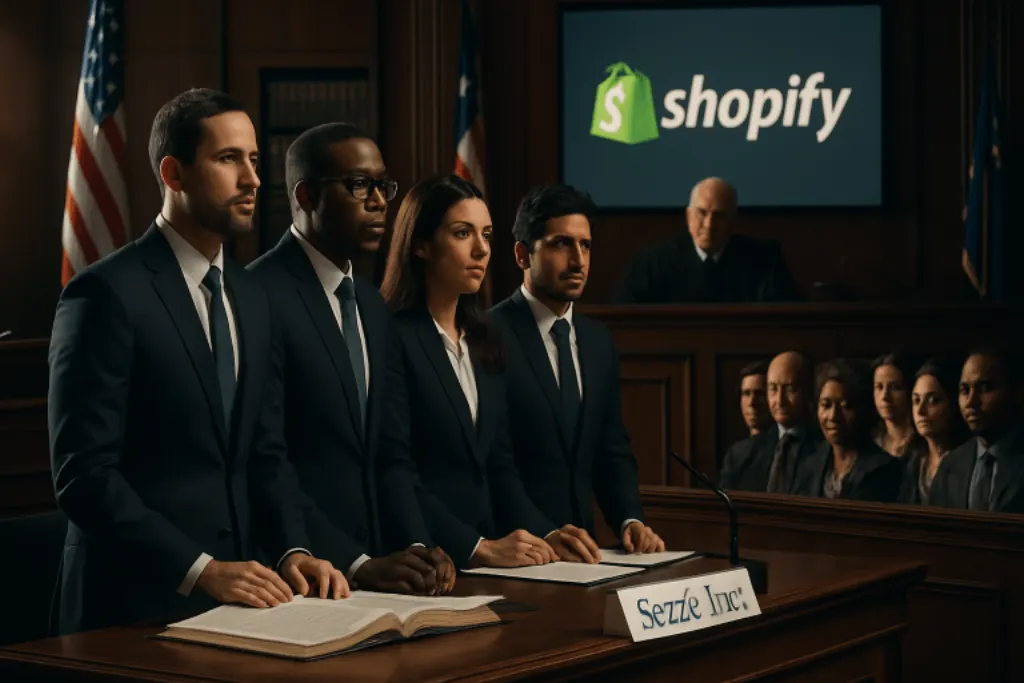
In a recent legal twist, Canadian e-commerce giant Shopify has asked a U.S. judge to dismiss a lawsuit filed by Sezzle, a buy now, pay later (BNPL) service provider. Sezzle accuses Shopify of stifling competition in the installment financing sector, citing antitrust violations. Amid this legal battle, giants such as Klarna, Afterpay, and even PayPal are watching closely, curious to see how this case could redefine the rules of the e-commerce market. How did this legal standoff come to be, and what are the potential implications for the future of online payments?
Related reading : Shopify works to end lawsuit against Sezzle
Related reading : The Deferred Payment Battle: Sezzle Accuses Shopify of Bending the Rules in Favor of Its…
An Accusation of Unfair Practices: The Heart of the Conflict
At the heart of this ongoing case, Sezzle accuses Shopify of manipulating its payment system. According to Sezzle, Shopify allegedly made the checkout process disadvantageous for installment payment options other than those offered directly by Shopify. By imposing a complex verification process for competing services, Sezzle claims that Shopify is pushing consumers to use its own BNPL system, Shop Pay Installments. The latter, launched by Shopify in 2021, is presented as a convenient, integrated alternative for customers who want to spread their payments.
Sezzle’s lawyers also point to substantial fees imposed on merchants using other BNPL services. These fees, according to Sezzle, constitute a penalty for those who choose not to use Shop Pay. The lawsuit argues that these practices stifle competition by using Shopify’s market power to make its BNPL service the default choice.
This lawsuit is based on an interpretation of U.S. antitrust laws, including the Sherman Antitrust Act and the Clayton Act. Essentially, Sezzle argues that Shopify is using its dominant position to prevent fair competition, thereby harming innovation and the diversity of payment options for merchants and consumers.

However, Shopify counters by stating that Sezzle’s entire allegations are simply an expression of dissatisfaction with the increased competition it faces. Shopify argues that its product design decisions are in no way obligated to favor the interests of its rivals, even if that means limiting their compatibility or affecting the quality of their offerings. https://www.youtube.com/watch?v=oIrNxNStPA0
Notable Precedents in the World of E-commerce
The Shopify-Sezzle case is not an isolated one in the digital business world. Several legal precedents have shaped how anticompetitive practices are interpreted in the marketplace. A famous example is Microsoft in the 1990s, which was sued for bundling Internet Explorer with its Windows operating system, essentially marginalizing its competitors. The court’s decision ultimately ordered Microsoft to cease this practice, paving the way for stricter regulation of tech giants.
A similar situation occurred with Google, which was accused of promoting its own services over those of competitors in its search results. As these cases have shown, the heart of legal interpretation often lies in the balance between innovation and competitive fairness. Case
Defendant Company
Antitrust laws were established to ensure that companies operate within a healthy competitive framework, thus preventing abuses of market power and fostering innovation. These laws aim to protect not only competitors, but more importantly, consumers, who benefit from a diversity of offers and fair prices.
In the case of Shopify and Sezzle, the debate revolves around the legitimacy of Shopify’s practices in favor of its own installment payment service. By establishing barriers for competitors, Sezzle argues that Shopify violates the fundamental principle of competition. The plaintiffs argue that if large companies were allowed to impose conditions that invariably marginalize smaller ones, this could crush emerging innovations.
What specific role do antitrust laws play in this clash? The Sherman Antitrust Act, one of the main laws invoked by Sezzle, explicitly prohibits practices that restrain trade and competition. At the same time, the Clayton Act targets potentially anticompetitive behavior before it causes irreparable harm to the market.
Shopify, for its part, maintains its position, stating that its intention is not to monopolize the market, but rather to offer an integrated, end-to-end user experience for its merchants. Shopify’s defenders emphasize that innovation should not be hindered by excessive regulatory constraints that could harm consumers by limiting the range of available solutions.
Shopify formally requests the court dismiss the lawsuit filed by Sezzle, contesting the allegations against it in this legal case related to the e-commerce sector.
Analyzing the potential impact of this trial on the industry, several experts predict that the verdict could significantly influence how companies structure their product offerings in the future. With technology changing at a breakneck pace, companies must constantly adjust their business models to remain relevant and competitive.

Complying with the regulatory framework while innovating remains a challenge for large companies.
The balance between protecting competition and promoting innovation is crucial.
- Previous verdicts often inform future decisions, laying the groundwork for fair trade. https://www.youtube.com/watch?v=pAE8O0kSbCc
- Undoubtedly, the outcome of this case could influence all market players, not just Shopify or Sezzle. Companies like Affirm, Bolt, and Mollie, operating in the digital payments space, are already strategically recalibrating their competitive positions, hoping to avoid falling victim to antitrust laws.
- Potential Consequences for the E-commerce Industry
In the context of a global digital economy, the implications of such a verdict could redraw the map of business models. If Shopify is forced to relax its rules for its competitors’ solutions, it could set a precedent for other tech giants. These companies could be forced to review their internal policies to ensure they do not violate antitrust laws.
Related reading : Sezzle Inc. files antitrust lawsuit against Shopify
How might such a decision influence corporate behavior? First, it could encourage smaller entities to innovate, knowing that market penetration avenues would not be blocked by the giants. A ruling in favor of Sezzle could also encourage more players to challenge seemingly unfair business practices, even if this involves greater financial and legal consequences.
Shopify has formally asked the court to dismiss Sezzle’s lawsuit, claiming the allegations are unfounded. Discover the details of this legal case between two major players in online payments. Furthermore, this case highlights a central issue: protecting consumer interests in a rapidly evolving digital market. Consumers seek not only diversity of services, but also transparency and fairness in the options available to them. From this perspective, better regulation could potentially guarantee these expectations, provided it does not hinder innovation.
Finally, public opinion also plays a role in this complex puzzle. Consumers are increasingly aware of the business practices of the companies they support, and the repercussions of any perceived misconduct can be significant. Tech giants, fearing backlash, are often quick to respond to market demands, even if it means revising their competitive strategies.
Smaller market players could benefit from greater leeway.

An emphasis would be placed on transparency and fairness to maintain consumer trust.
#eCommerce 🎴 Migrer vers Shopify présente de nombreux avantages
🟢 Simplicité d’usage
🟢 Flexibilité optimale
🟢 Interfaces intuitives
🟢 Processus de commande simplifiés
➡️ Augmenter vos taux de conversion.
•#Shopify #DigitalBusiness
✍️ @BldWebhttps://t.co/zsgKGb3dRv— Audrey Tips (@audreytipsfr)
- Faced with these challenges, the business community is closely monitoring what could be a turning point in e-commerce regulation. While the giants take strategic positions, smaller players hope for a more balanced landscape. The outcome of the legal battle could be decisive for the future of digital transactions and international trade.
- Financial Repercussions for Shopify
- Another dimension to consider in this case is its potential impact on Shopify’s finances and reputation. Even as the company seeks to dismiss the lawsuit, it must also ensure it maintains the trust of investors and business partners. An adverse verdict could not only lead to adjustments in Shopify’s business practices, but also affect shareholder sentiment.
Outlook
Potential Impact
Economic
Potential for changes in business practices
Maintain clear communication with investors.
Ensure compliance with new regulations as they emerge.
As the trial date approaches, it is imperative for Shopify to navigate this case carefully. The company is at a crossroads where every move must be strategic, considering not only the legal implications, but also the long-term impacts on its economic growth and reputation.
- Learn more about Shopify’s economic performance
- as we closely follow this compelling case.
Read next
 Shopify
Shopify works to end lawsuit against Sezzle
Shopify, one of the pillars of global e-commerce, is now in the spotlight, but for reasons it would prefer not to. Sezzl
 Shopify
Sezzle Inc. files antitrust lawsuit against Shopify
Sezzle Inc., a leading fintech company, recently shook the industry by filing an antitrust lawsuit against Canadian gian
 Shopify
The Deferred Payment Battle: Sezzle Accuses Shopify of Bending the Rules in Favor of Its Own Payment Option
In a case that has shaken the e-commerce world, the American startup Sezzle is accusing Shopify, the Canadian e-commerce
 Shopify
Shopify faces lawsuit over customer data collection
Shopify, a globally recognized Canadian e-commerce platform, is facing a major lawsuit in the United States related to c