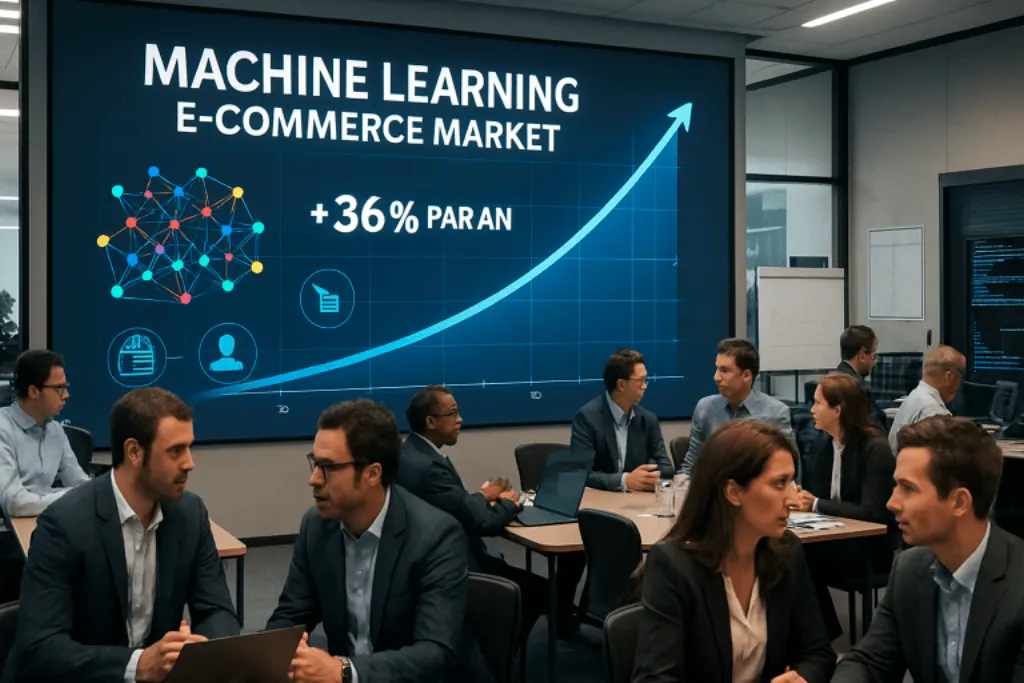
the size of the machine learning market in e-commerce: an annual growth of 36%
Contents5
The machine learning market in the e-commerce sector is booming, growing at a rate of approximately 36% annually. This is driven by a growing demand for technological solutions capable of transforming the way businesses interact with their customers, adjust their prices, and manage their inventories. In 2024, the market was valued at USD 4.4 billion and is expected to reach nearly USD 98.9 billion by 2034. North America dominates this sector with a market share of over 38%, closely followed by Asia-Pacific. This growth is accompanied by numerous innovations that can be transferred to various applications, constantly redefining the customer experience and business operations. So, how are online platforms and market giants, such as Amazon and Alibaba, capitalizing on these advances? Drivers of Machine Learning Growth in E-commerce The increased use of machine learning in e-commerce is driven by several key factors. Above all, optimizing customer engagement through personalized experiences is a major advantage. Amazon, for example, uses machine learning algorithms to analyze purchasing behaviors and offer tailored recommendations. This approach results in significantly increased conversion rates and stronger customer loyalty. Discover how the machine learning market in e-commerce is growing at an impressive 36% annually. Explore the trends, opportunities, and impact of this technology on the future of e-commerce. In addition to personalization, machine learning significantly improves inventory management and logistics. Platforms like eBay and Shopify use these algorithms to predict demand, reducing costs associated with overstocking or stockouts. Companies can thus adjust their supplies in real time, ensuring optimal operational efficiency.
The flexibility of cloud-based solutions also allows companies to quickly deploy machine learning models without massive infrastructure investments. This scalability is particularly crucial in the dynamic e-commerce sector, where needs evolve rapidly according to market trends.
https://www.youtube.com/watch?v=5UTcCUbQtFw Other advantages of these solutions include the ability to analyze and manipulate large data sets. Giants such as Alibaba and Rakuten are leveraging this capability to adapt their marketing strategies and refine their advertising campaigns in real time. Challenges of Integrating Machine Learning Integrating machine learning into existing infrastructures poses significant challenges. For example, a recurring issue is data quality and management. Many businesses face disparate and incomplete data, which can negatively impact model performance. This issue requires constant investment to maintain a consistent and up-to-date database. Furthermore, the scalability of solutions is a concern. SMEs, in particular, may struggle to deploy and maintain effective machine learning solutions due to limited computing power. Robust computing resources are crucial for processing data in real time without failures. In conclusion, machine learning offers tremendous growth and optimization opportunities for e-commerce, but requires a rigorous approach to data and infrastructure management.

Machine learning plays a key role in several application areas within e-commerce. Personalized product recommendations are one of the most visible and effective applications. For example, Pinterest, famous for its visual discovery engine, applies machine learning algorithms to suggest pins and products tailored to users’ tastes, thus increasing user engagement. Next, real-time price optimization represents a strategic use of machine learning. Platforms such as Shopify and Criteo optimize their sales prices based on data collected from advertising campaigns and user consumption habits. This pricing flexibility helps improve competitiveness and maximize sales profits. Application Description Benefits Personalized Recommendations
Analyzes purchasing behaviors to offer tailored products.
Price Optimization Dynamic price adjustments based on demand and supply. Increases competitiveness and profit margins. Inventory Management Accurate predictions of inventory needs.
Reduces overstocking costs and avoids stockouts.
Fraud prevention is another important application of machine learning. By analyzing typical customer behavior, systems can detect anomalies and prevent fraudulent transactions, thus protecting both consumers and businesses.
Likewise, sentiment analysis and customer feedback offer unique insights to improve user experience. By analyzing reviews and comments left by customers, algorithms can identify negative trends and proactively correct weak points in the customer journey.
The impact on customer service and satisfaction
Finally, the automation of customer service through chatbots and other intelligent tools has revolutionized customer support. Algorithms enable real-time response to customer queries, reducing the need for human intervention and improving support efficiency. This range of applications demonstrates how machine learning is transforming the e-commerce industry, making every interaction more intuitive and personal. https://twitter.com/isostandards/status/1846185174775578847 Future prospects for machine learning in e-commerceLooking to the future, technological advances continue to redefine the potential of machine learningin the
e-commerce . The integration of immersive technologies such as augmented reality (AR) and virtual reality (VR) with machine learning is paving the way for exciting innovations for the industry. For example, using augmented reality to offer virtual product try-ons or contextual home viewings provides deeper interaction with items. This can significantly reduce the rate of returns, while increasing customer satisfaction and conversion rates. discover how the machine learning market in e-commerce is experiencing impressive annual growth of 36%. explore the trends, opportunities and impacts of this technological revolution on businesses. With technological progress, especially from companies like Nvidia
As a result, as giants like Amazon and eBay push the boundaries of machine learning’s capabilities, they set a precedent for smaller players, pushing them to adopt these technologies to stay competitive. Additionally, the rise of online platforms means increasing inclusiveness, allowing users to have a more personalized and dynamic experience.
A future redefined by data
It is obvious that the impact of machine learning today goes far beyond the scope of e-commerce. In the years to come, its ability to transform business operations will set new standards in efficiency, customer satisfaction and innovation.
As machine learning continues to infiltrate every aspect of e-commerce, it becomes essential for businesses to understand not only its potential, but also its practical and ethical implications.
In conclusion, as demonstrated by major platforms such as
Or
Nvidia , machine learning is transforming the e-commerce sector by offering new growth opportunities, while redefining consumer expectations for an ever more optimized and personalized experience.

https://www.zalando.fr/ https://www.fnac.com/
https://www.lemonde.fr/economie/article/2025/05/11/comment-l-ia-se-prepare-a-bouleverser-le-secteur-du-commerce_6604882_3234.html https://www.nvidia.fr
Read next
 E-commerce news
The maritime stock market is booming thanks to double-digit growth in the e-commerce, fintech and gaming sectors
The maritime stock market is booming, driven by incredible growth in diverse sectors such as e-commerce, fintech, and ga
 E-commerce news
Less-Than-Truckload (LTL) Market Growth Projected to USD 110.7 Billion (2025-2029): The Rise of E-Commerce Powers This Expansion, While a Report Examines the Impact of AI on This Transformation.
The global Less-Than-Truckload (LTL) market is poised for significant expansion. Estimated at USD 110.7 billion between
 E-commerce news
Naspers’ annual profit soars thanks to booming e-commerce and Tencent
In 2025, South African company Naspers posted remarkable annual profit growth, driving the global digital economy. With
 AI news
Discover the incredible benefits of machine learning in your daily life!
Introduction Machine learning, also known as machine learning, is a field of artificial intelligence that allows compute